
Towards a new history of the bass clarinet
Geschichte, Bauweise und Repertoire der Klarinetteninstrumente
Media - Book - History
29. Musikinstrumentenbau-Symposium Michaelstein, 24. bis 26. Oktober 2008
Herausgegeben von Boje E. Hans Schmuhl in Verbindung mit Monika Lustig
Albert R. Rice
Towards a new history of the bass clarinet
This paper summarizes chronologically eighteenth and nineteenth century bass clarinet history and instrument designs. The makers, their designs, music, and virtuoso players are included in my book, From the clarinet d'amour to the contra bass: a history of large size clarinets, 1740-1860.1 The instruments included in this paper were made from the mid eighteenth century to about 1860 in seven shapes: plarik body; curved basset horn; bassoon; serpent; straight; ophicleide; and straight with butt joint. Most of the surviving eighteenth and nineteenth century bass clarinets are made in bassoon and straight form.2
New discoveries and little known topics discussed include the reclassification of the instrument in Gilles Lot's 1772 magazine advertisement from a bass clarinet to a basset horn; a description of the earliest surviving bass clarinet solo in Saverio Mercadante's opera Emma d'Antiochia (1834); the establishment of Nicola Papalini's approximate working period and dates of his serpent shaped bass clarinets; a review of Frédéric Widemann's little known ophicleide shaped bass clarinet; and a look at a straight bass clarinet with a butt joint.
The development of the bass clarinet was motivated by the desire of makers, players, and composers for a strong woodwind voice in the bass register other than the contra bassoon, for bands and orchestra. It was developed after the initial appearance of clarinets d'amour and alto clarinets during the 1730s and before the basset horn during the 1760s. Makers constructed bass clarinets in various shapes working to achieve an easy holding and playing position with accurate intonation.
The three plank (and one curved basset horn) shaped instruments are the earliest and represent experimental or prototype bass clarinets. Today, they are fascinating for their ingenious design and features found on later large size clarinets. The first instrument we will examine is a plank shaped bass clarinet in Brussels. It has the same keys as a three-key clarinet (see fig. 1): speaker, A, and an E/B key positioned for the left little finger. The large size requires a brass crook and large mouthpiece; the cylindrical body has a wooden plank attached, both entirely covered with leather. The plank has sufficient width for the maker to drill seven finger holes at oblique angles and a thumb hole. At the base, there is a brass tube bent at an acute angle with a large decorative arrow and upturned brass bell. Mahillon lists its compass only for the low register, describing the sound as poor with bad intonation overall, attributing these problems to defective air column proportions.3 The brass neck, decorative bell, and one piece mouthpiece-barrel may be nineteenth century replacements, as suggested by Phillip Young.4 However, the leather covered body and saddle mounted keys appear to be of mid or late eighteenth century origin.
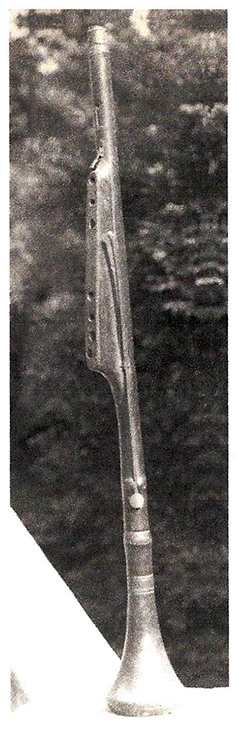
A prototype plank bass clarinet (see fig. 2) is in a small museum in the Italian speaking village of Sonogno, Switzerland.
It has three keys; is missing its brass crook and mouthpiece; and features a straight, wooden bell. This instrument has an A key; a tone hole on the front for a speaker key; and it appears that a linkage from the speaker to the thumb key is now missing. The placement of the speaker may have been altered at a later date. There is an E/B key for the left little finger. The round key heads and the saddle and block mounting suggest a date about 1780 or later.5
In the Galleria dell'Accademia in Florence another, later plank bass clarinet (see fig. 3) has a slightly more sophisticated construction with several eclectic characteristics: six saddle mounted keys with rectangular key heads; non-original mouthpiece resembling those used on clarinets d'amour; and bell resembling a basset horn brass bell. It includes keys for speaker, A, f/c for the left second finger, Ab/Eb, F#/C#, and E/B, equivalent in fingering to a five-key clarinet. The seventh finger hole for F/C covered by the right little finger is on the right side of the wing joint adjacent to the Ab/Eb key touch. A strap ring is on the back of the cylindrical body.6 My dating of 1790 to 1810 is approximate based on the number and design of keys. Since this shape was not continued, it seems doubtful that these three prototype bass clarinets were successful playing instruments.
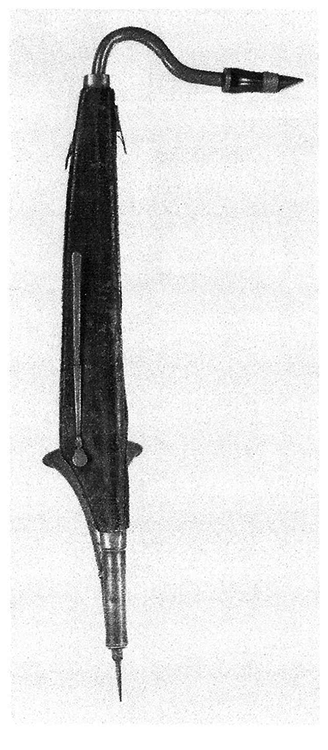 |  | |||||
| Fig. 1 |
Three-key bass clarinet, anonymous, mid or late eighteenth century (Brussels, muziekinstrumentenmuseum, inv. no. 939) | Fig. 2 |
Three-key bass clarinet, anonymous, about 1780 (Sonogno/Switzerland, Museo di Val Verzasca) | |||
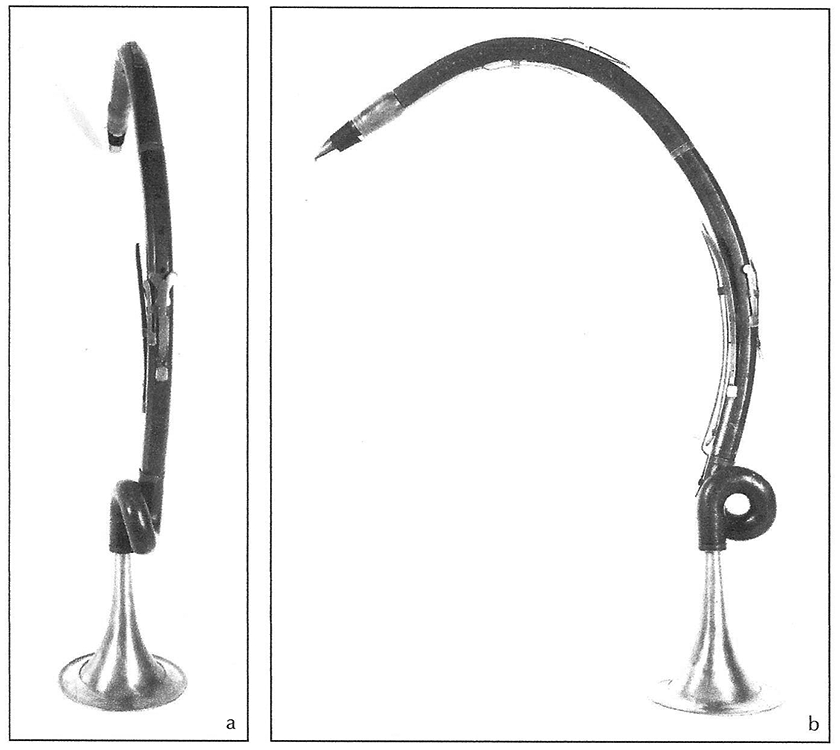
A unique curved basset horn shaped bass clarinet in Munich (see fig. 4) was made between 1760 and 1770 by the Mayrhofers of Passau, well known for their claim as inventors of the basset horn. Its three part curved body is similar to the earliest curved basset horns but instead of using a box, where the bore takes three turns before emerging through a brass bell, the makers use a round wooden coil (see fig. 4b).7
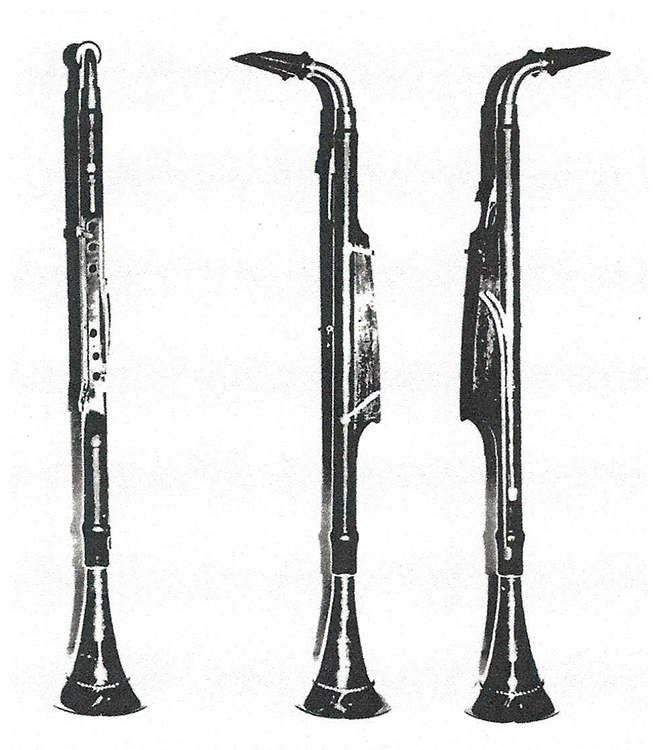 | ||
| Fig. 3 |
Six-key bass clarinet, anonymous, between 1790 and 1810 (Florence, Museo degli Strumenti Musicali del Conservatorio "L. Cherubini", inv. no. 109) |
Although some writers consider this instrument a low pitched basset horn and it includes the basset horn's lowest notes of E/B and C, its bore of 16.7 mm and Bb pitch are characteristics that conclusively classify it as a bass clarinet. The unusual round wooden coil is also found on an anonymous bass oboe in Paris (Musee de la Musique, inv. no. E.479) attributed by Michael Finkelman to the Mayrhofers.8 The Parisian maker Gilles Lot wrote the following advertisement in 1772:
"New musical instrument. Mr. G. Lot, a wind instrument maker living at the Cour des Moines in the Abbaye St. Germain, opposite the fountain, has just produced a new musical instrument, called a Basse-Tube, or a clarinet bass. No one has yet seen an instrument with such a considerable compass. It covers three and a half full octaves; reaches as low as the bassoon, and as high as the flute. This instrument, which has a very distinctive shape, is equipped with several keys for the use of semi-tones, all very artistically arranged with a very ingenious mechanism. The tone it produces is very pleasant and so perfectly modulated that the lower notes sound almost like those of an organ in the pedal register. When a skilled artist plays this instrument it will certainly sound very agreeable, and will have the public's approval whether it is heard by itself or as part of an orchestra."9
 | ||
| Fig. 4 |
Bass clarinet by Mayrhofer, Passau, between 1760 and 1 770 (Munich, Stadtmuseum, inv. no. 52-50) a) front view b) rear view | |
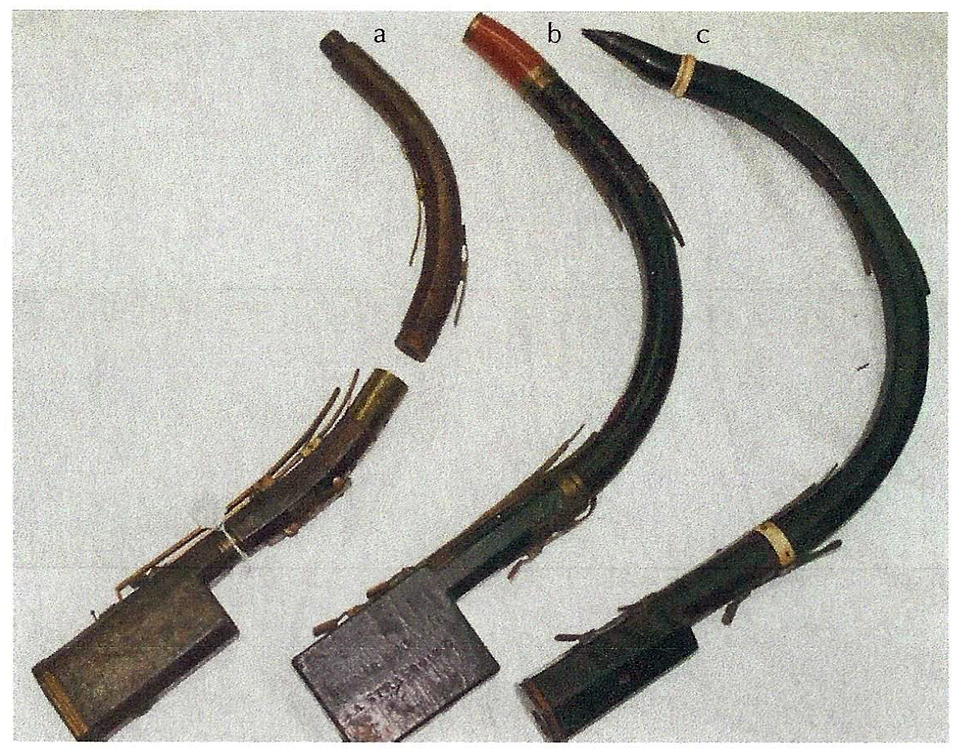
This rather vague description was thought by Constant Pierre and other nineteenth century writers to be a bass clarinet but the description is not sufficiently detailed to classify the instrument with certainty. In addition, Jean Jeltsch pointed out at the Edinburgh Clarinet Conference in 2007 that on 30 August 1769, the German performer Leopold Valentin played a concerto in Lyon. The announcement from the 30 August Affiches Lyon reads "Mr. Leopold Valenti, German virtuoso, will play a concerto of his own composition on a newly invented instrument that has never appeared in France." 10 It seems probable that Leopold Valentin was the M. Valentin who played "sur le corno-basseto ou contra-clarinette" at a Concert Spirituel announced in the Mercure de France in April 1774. 11 Furthermore, Valentin's instrument seems likely to have been similar to three surviving French curved basset horns (see fig. 5) made by Michel Amelingue of Paris (c. 1775), Dominique Porthaux of Paris (c. 1790), and Biihner & Keller of Strasbourg (c. 1795). The previous identification of Lot's instrument as a bass clarinet now appears to be incorrect, particularly in view of the lack of examples and reports of French eighteenth century bass clarinets.
 | ||
| Fig. 5 |
Basset horns by Michel Amelingue, Paris, c. 1775 (a), Buhner & Keller, Strasbourg, c. 1795 (b), and Dominique Porthaux, Paris, c. 1790 (c), (Paris, Musee de la Musique, inv. no. E.2002.11.12; E.603; E.189) | |
 |  | |||||
| Fig. 6 |
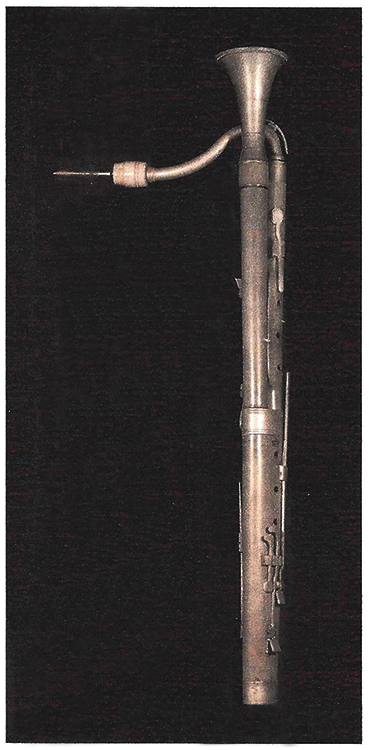
Bass clarinet by Heinrich Grenser, Dresden, 1793 (Stockholm, Musikmuseet, inv. no. M2653) |
Fig. 7 |
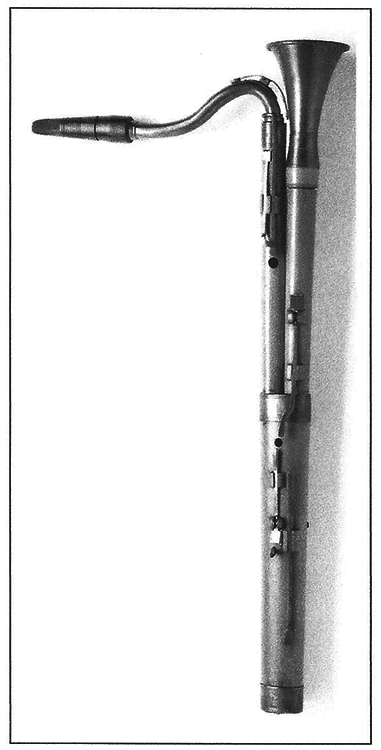
Bass clarinet by August Grenser, Dresden, 1795 (Darmstadt, Hessisches Landesmuseum, inv. no. Kg 67:133) | |||
The most common type of bass clarinet is the bassoon shape, popular throughout most of the nineteenth century. The skilled woodwind maker, Heinrich Grenser of Dresden, made the first working bass clarinet; his only extant instrument is dated 1793 and consists of seven sections: mouthpiece; ivory barrel; brass crook; wing joint; butt joint; long joint; and brass bell (see fig. 6). The instrument has eight block mounted keys: speaker, A, Ab/Eb, F#/C#, F/C, E/B, D, and B1. 12 The last three keys are on the back of the butt joint positioned for the right thumb, as shown on August Grenser's very similar 1795 bass clarinet (see fig. 7). Above the closed E/B touch is a hole for the right thumb which is between the open low D and B1 touches. Covering this thumb hole alone produces a D#; covering the right thumb hole with the D key closed produces a C. This design incorporates the five keys of contemporary clarinets. August Grenser's bass clarinet includes an advanced feature: two speaker keys, the second block mounted with its key head in a brass saddle on the crook. The touch is made so that a circular linkage raises the key head on the crook.13 Unfortunately, this instrument's playing characteristics must await a more accurate replica since the mouthpiece, barrel, and crook with an incorrectly made saddle mounted key are replacements.
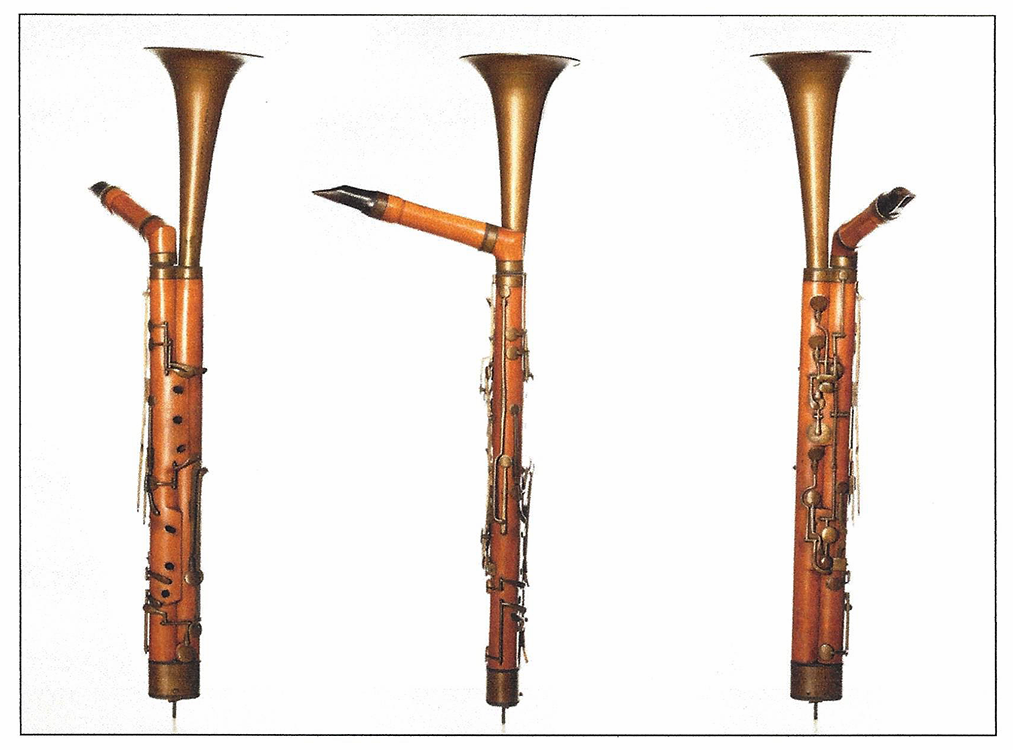 | |
| Fig. 8 | Bass clarinet by Johann Heinrich Gottlieb Streitwolf, Gottingen, c. 1835 (Gemeentemuseum, The Hague, inv. no. 0840392) |
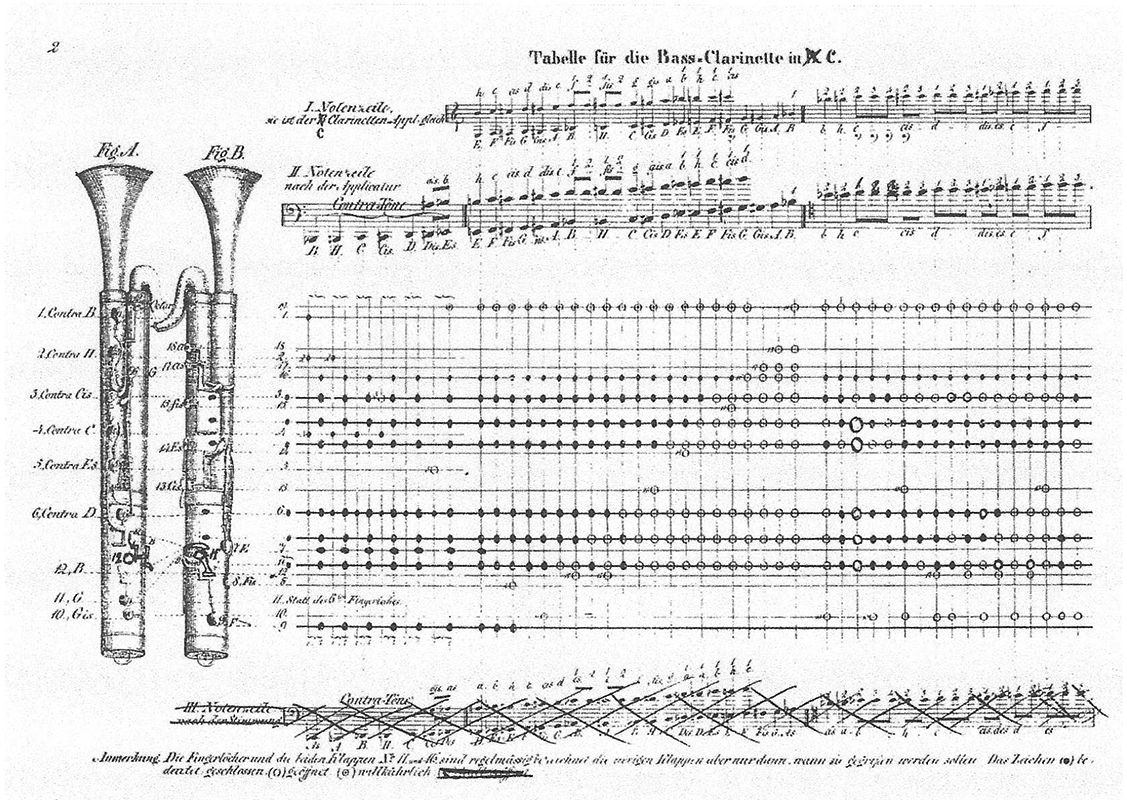 | |
| Fig. 9 | Johann Heinrich Gottlieb Streitwolf, Anweisung, die Bass-Clarinette kennen und blasen zu lernen, Mainz 1833, p. 2 |
One of the most accomplished makers of bassoon shaped bass clarinets during the nineteenth century was Johann Heinrich Gottlieb Streitwolf of Gottingen. Of his eight surviving bass clarinets, the earliest is an example in C (Sondershausen, Schlossmuseum, inv. no. Mu3) constructed of boxwood in seven sections: mouthpiece; barrel; elbow joint; one-piece wing joint with six finger holes; butt joint; one-piece long joint; and brass bell. The most sophisticated bass clarinet of its time, Streitwolf's first instrument includes seventeen post and pillar mounted keys with thumb keys for low C, B1, and Bb1 and one plateau or open standing key for the thumbs of each hand. 14 A similar bur more complex example in Bb (see fig. 8) has twenty-one keys including two plateau keys.15 An 1833 fingering chart published by Schott in Mainz and supplied to buyers shows an example with a brass crook instead of a wooden elbow joint (see fig. 9). The compass is extensive, from low Bb in the bass clef to f3 in the treble clef.16 A Streitwolf Bb bassoon shaped bass clarinet in Nuremberg (Germanisches Nationalmuseum, inv. no. MIR 477) includes a brass crook and represents the most advanced model with a separate butt joint about the size of that on the bassoon, rather than two long joints fitted into a small brass butt section. The mechanism is similar to the previous instruments with the addition of rods attached to touches for G/D and Ab/Eb closing keys on the back side.17 Streitwolf's bass clarinets were played in various wind bands and chamber music and were the most successful before the straight bass clarinets of Louis Auguste Buffet and Adolphe Sax.
Another significant instrument is a bass clarinet with an advanced fingering system by Catterino Catterini of Padua (see fig. 10). Although made in a bassoon form its body is unusually constructed of a single block of boxwood in an oval section with two parallel bores; mouthpiece; brass crook; and upward pointing boxwood bell. 18 It has been suggested that the maker Giancito Riva of Persiceto, Italy made this instrument for Catterini.19 There are twenty saddle mounted keys, including two speaker keys (see fig. 106) and a diatonic range from E to C and low Bb1. It also has eight plateau keys, three for the fingers of each hand and two for the thumbs on the back side. For some notes, the thumb of either hand must hold down an open key and another key at the same time. The instrument's stamp includes the number "3" and "Premiata invenzione di Catterino Catterini" (first invention of Catterino Catterini). Thus, this instrument may be the third version of a bassoon shaped bass clarinet called "glicibarifono" developed by 1833.
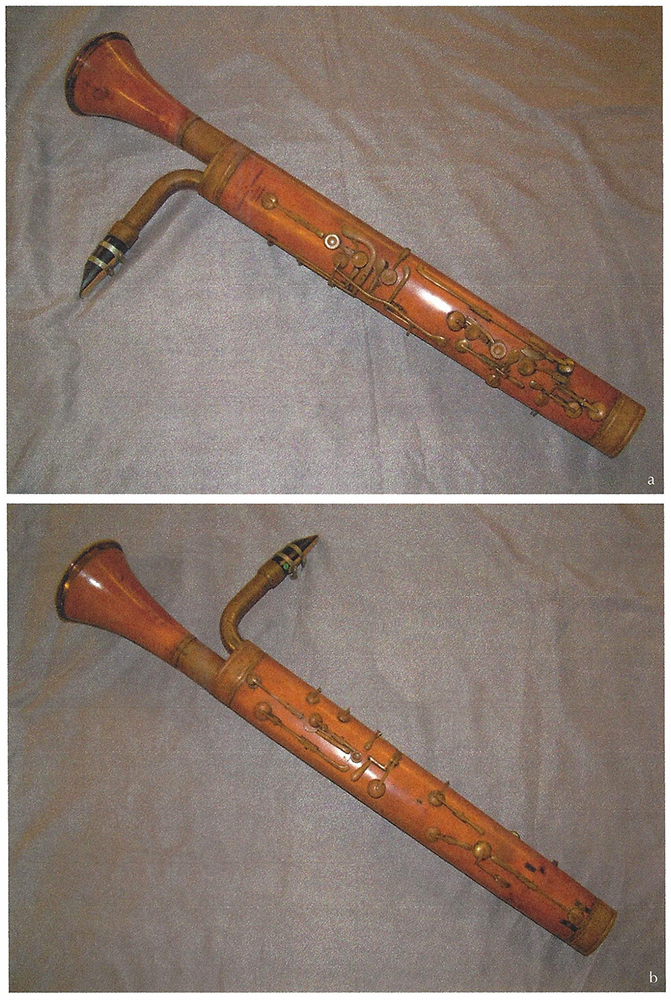 | ||
| Fig. 10 |
Bass clarinet by Catterini Catterino, Padua, c. 1834 (Oxford, University of Oxford, Bate Collection, inv. no. 496) a) front view b) rear view | |
In fact, this may have been the instrument played by Catterini himself in several performances of the earliest known bass clarinet orchestral solo (fig. 11) written in Act 2 of Saverio Mercadante's opera Emma d'Antiochia produced in Venice in 1834. This solo is long and technically demanding with the use of treble, tenor, and bass clefs. 20 Catterini performed it several times and others such as a "Variazioni con l'Eco" by Bellini and an aria from Donizetti's Anna Bolena listed on a 12 February 1838 concert notice at the Modena Theatre.21 However, other Italian performers played the bass clarinet. During the 1839 to 1840 Venetian opera season, the clarinettist and inventor Pietro Fornari played a glicibarifono in a performance of Emma d'Antiochia. Fornari is known as a bass clarinet inventor and probably played his own instrument. 22 Although Emma d'Antiochia was very successful in Italy, Spain, and Portugal during the 1830s and 1840s,23 it was not performed in Paris and never entered the general European repertory. This opera was revived for a London concert performance as recently as 2003 and first recorded in 2004.
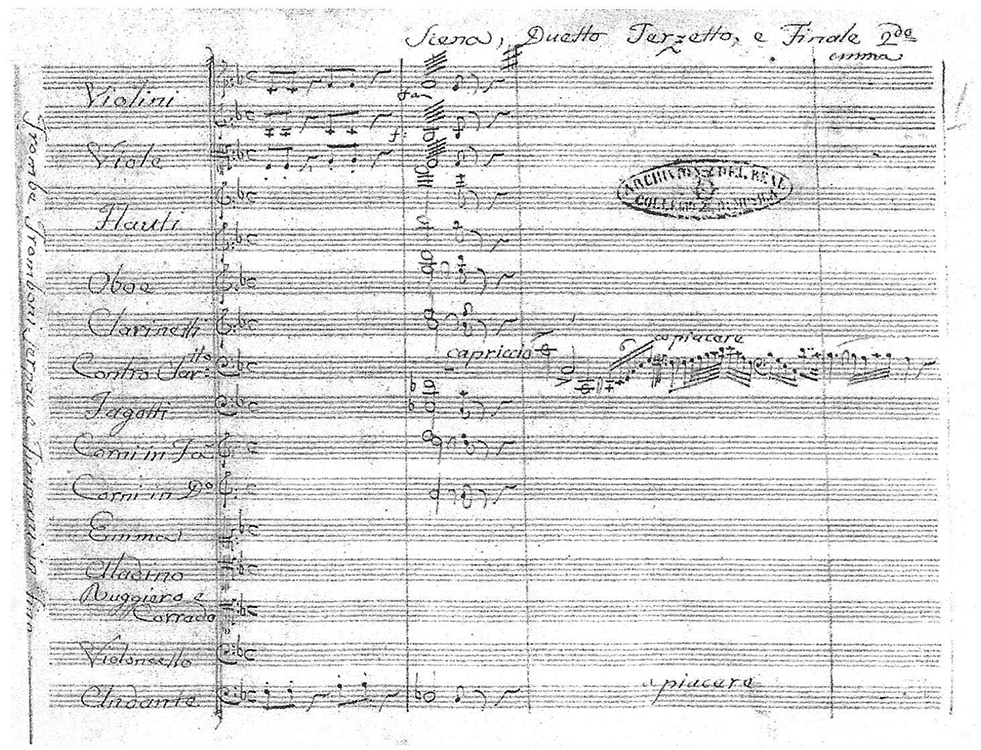 | ||
| Fig. 11 | Saverio Mercandate, Emma d'Antiochia (1834) | |
Five serpent shaped bass clarinets in C by Nicola Papalini of Chiaravalle near Ancona are well known. Recently a parish register of 1826 was found with Papalini listed at age 45 with his wife of 47 and two children of 16 and 13. A Domenico Papalini and family members are listed in an 1816 register, and it is possible that Nicola and his family arrived in Chiaravalle close to this time.24 These facts establish his age and suggest that his bass clarinets date from the 1820s; his last instrument, a serpent shaped alto clarinet in F, carries a date of 1829. A beautiful example of a Papalini bass clarinet in Brussels includes five keys (see fig. 12); the twisted shape of the body enables the finger holes to be placed closer but the fingering of some notes is awkward. Three of his bass clarinets include double holes for playing half steps. Thus, the tip of the left first finger covers a single or double hole and the single hole on the outside of the curve is covered by the lowest joint of the same finger. Also, the third finger of the right hand must cover either a single or double hole depending on the note required. On this instrument, there is an oval shaped resonance hole not covered with a finger, towards the outside of a curve below L3, and another on the bell to correct intonation. The register and E/B keys are located on the back.25
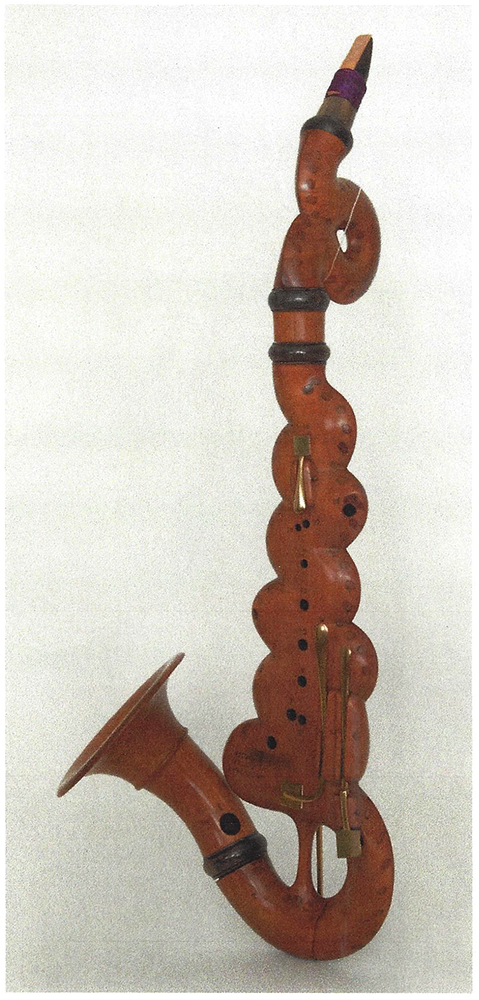 |
Fig. 12 Bass clarinet by Nicola Papalini, Chiaravalle, c. 1820 (Brussels, muziekinstrumentenmuseum, inv. no. 940) |
In later serpent shaped instruments, Papalini simplified the fingering, removed the two double holes; placed the E/B key on the front; and used three round touches for Eb/Bb, B/F#, and Bb/F attached to rods that open keyheads on the back, as found on an example in Paris (Musée de la Musique, inv. nos E.760, C.550).26 A ten-key Papalini alto clarinet in Rome (Museo Nazionale degli Suumenti Musicali, inv. no. 617) has two more round touches connected to rods that open keyheads on the back for f/c and C#/G#. This instrument is now missing its mouthpiece; upper or coiled section; barrel; and upper section of its bell. It is dated 1829.27 Since only five serpent shaped bass clarinets and one alto clarinet are extant it seems that their use was limited to a few Italian players and wind bands.
In 1832, Franco Dacosta inherited a bass clarinet made by the Parisian wind maker Dumas. Beginning in 1833, Dacosta and Louis Auguste Buffet worked to improve this bass clarinet.28 Their instrument is an early Bb straight shape (Paris, Musee de la Musique, inv. no. E.0644, c. 1834) with thirteen keys, two plateau keys for L3 and Rl, and a straight wooden bell. Two pillars and a metal platform on the back suggest that a second register key was subsequently added along with a key on th e missing brass crook, clearly adopting Sax's later use of two register keys. 29 This instrument is probably the type of bass clarinet that Meyerbeer had in mind when he wrote his famous bass clarinet solo (fig. 13) in Act 5, no. 15 of the highly successful opera, Les Huguenots, premiered in Paris in 1836.30
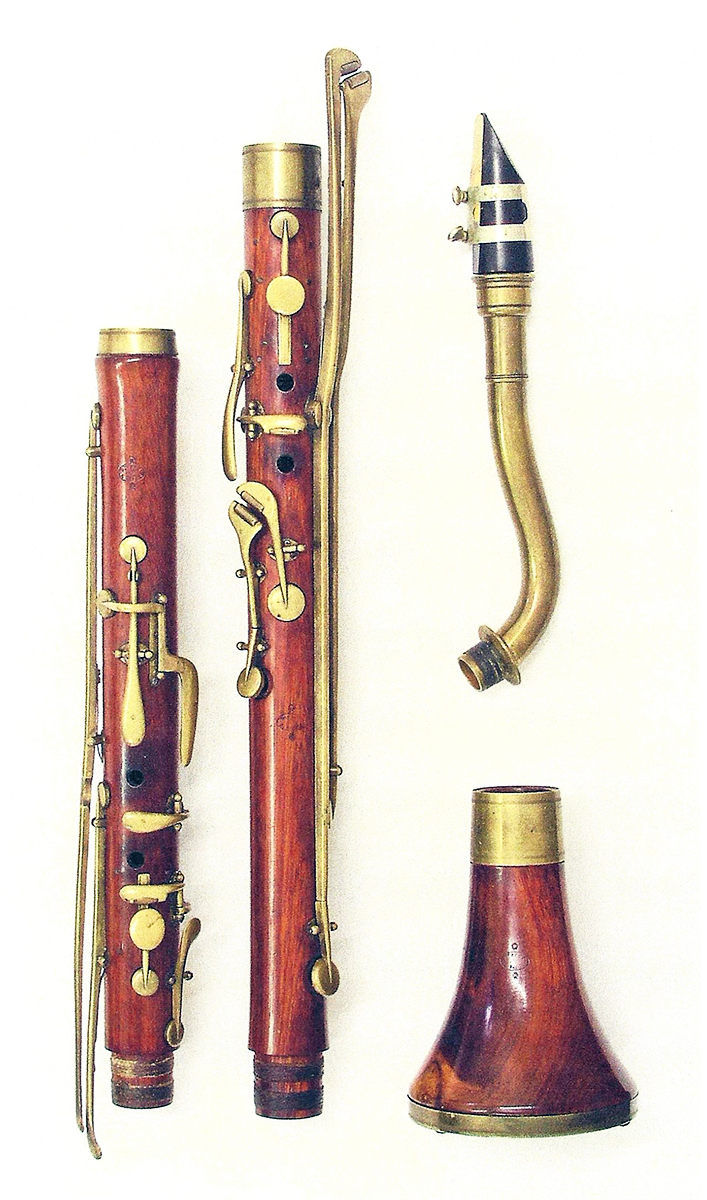
A very similar straight Buffet Bb thirteen-key bass clarinet (Munich, Bayerisches Nationalmuseum, inv. no. 117) was ordered from Buffet in Paris by the Munich Court Orchestra in 1838 for performance of Les Huguenots in a German translation. The well-known clarinettist and basset hornist Carl Baermann was asked to learn and perform Meyerbeer's difficult solo on this instrument in two weeks.31 The only differences between this instrument and the one in Paris are the addition of a cross f/c key rather than a lengthwise touch placed for the right hand first finger, a more rounded touch for the L3 plateau key, and a brass rather than a wooden bell. Another early straight Buffet C bass clarinet has fourteen keys with two plateau keys for L3 and R1 (see fig. 14). It is identical to the Paris example with the addition of a cross f/c key for L2 along with a long f/c key for R1, two rollers on the adjacent key touches for each little finger and one roller each for the touches of the Eb/Bb and Bb/F keys. 32 The Buffet bass clarinets were carefully made and include a bore from about 17.1 to 17.5 mm.
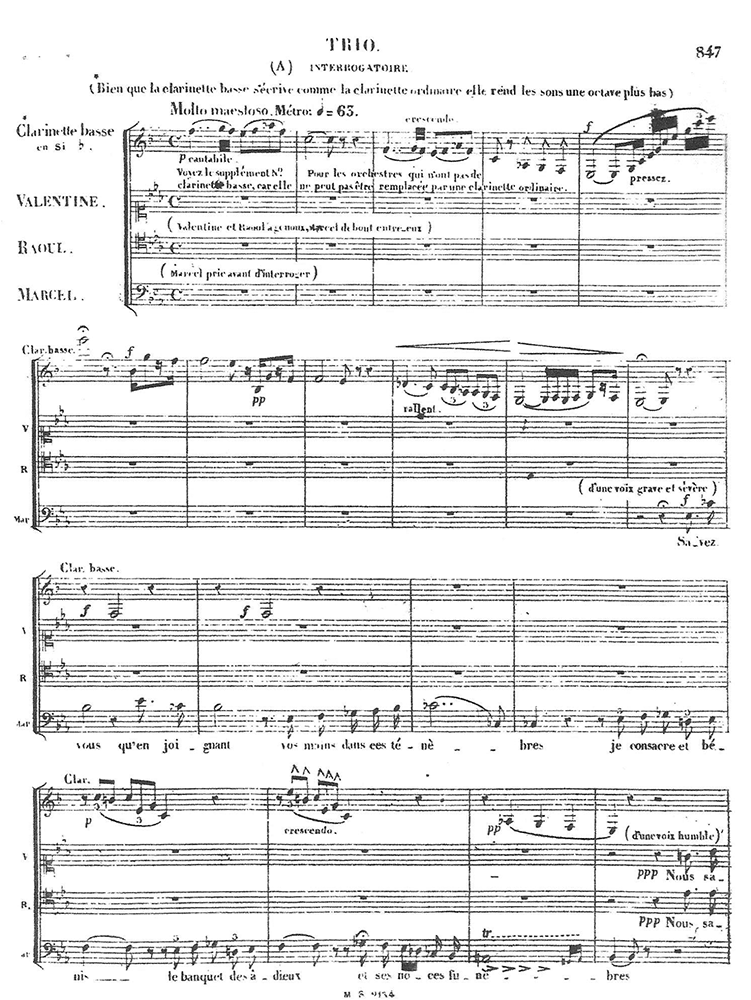 | ||
| Fig. 13 | Giacomo Meyerbeer, Les Huguenots, bass clarinet solo, Act 5, no. 15 | |
 | |
| Fig. 14 |
Bass clarinet, Louis Auguste Buffet, Paris c. 1837 (The Edinburgh University Collection of Historic Musical Instrument s, inv. no. 4948) |
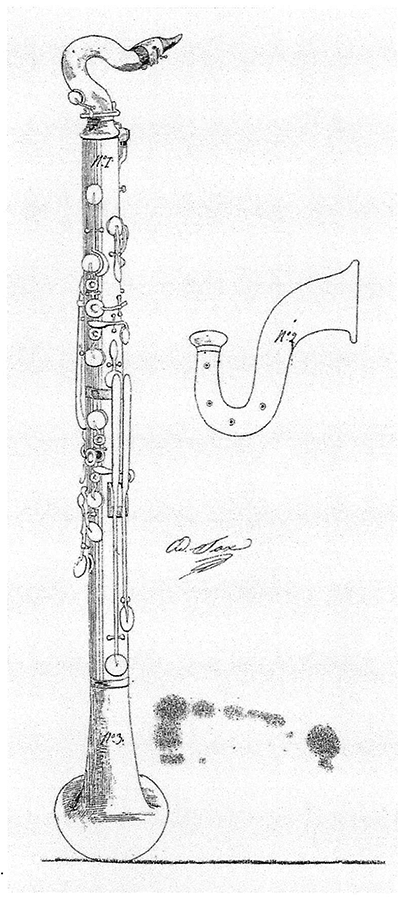 |
Fig. 15 Bass clarinet by Adolphe Sax, Belgian patent sketch, 21 June 1838 |
Between 1835 and 1837 Adolphe Sax produced his first bass clarinet and received a Belgian patent for its design in 1838. 33 The patent sketch (fig. 15) shows a mouthpiece on a large curved crook; straight two-piece body with large ferrules; thirteen keys; seven large plateau keys; and downward pointing bell. A second register key is positioned to cover a very small tone hole in a key seat placed high on the front side of the brass crook. The latter key was a genuine innovation and brilliant idea by Sax since, with its use, the response and equality of tones in the upper register were greatly improved. The ends of his touches are slightly curved or sloped; Sax preferred this construction instead of rollers. There is a crescent shape brass mount made to hold securely the long levers of the F#/C# and E/B keys. A second upward pointing, curved bell is pictured in the patent with four holes for Eb, D, C#, and C. However, none of Sax's extant bass clarinets or those attributed to him has survived with a curved bell fitted with four keys, and it is likely that he was not able to design a key extension that successfully produced these notes. Late Sax bass clarinets were made with upturned brass bells.
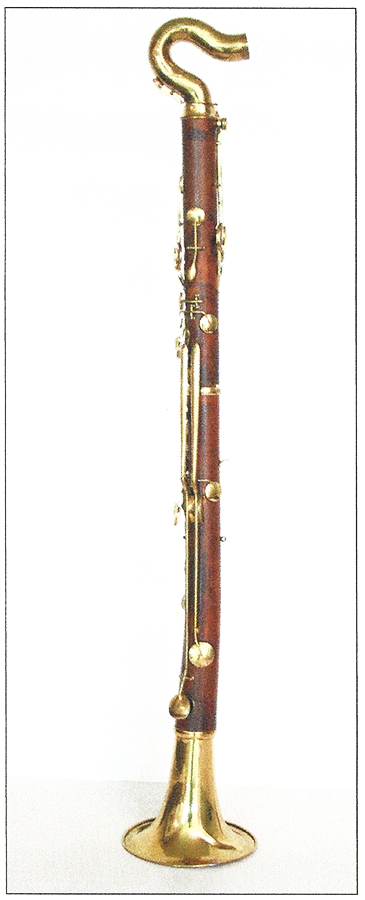 |
Fig. 16 Bass clarinet by Adolphe Sax, Brussels, c. 1838 (Ann Arbor, Michigan, Stearns Collection, inv. no. 637) |
Three surviving Sax bass clarinets are stamped "SAX/A BRUXELLES" and are presumed to have been made in Brussels by Adolphe Sax or under his supervision. The earliest instrument in Ann Arbor (see fig. 16) has thirteen keys and its two register keys placed as drawn in the patent; that is, one on the body and the second on the front of the brass crook. The bore of this bass is 22.9 mm.34 The two Sax bass clarinets in the Brussels Museum (inv. nos. M175, M2601) have fourteen and thirteen keys, the keyheads of both register keys are mounted on the back side of their crooks, and there is an additional Eb/Bb key for R1 on M2601.35 After Sax moved to Paris in 1842 he offered bass clarinets along with a large selection of brass instruments and eventually different sizes of saxophones. Although only eight stamped and three attributed bass clarinets by Adolphe Sax survive, many of his design features were incorporated by later makers of bass clarinets. These include large plateau and open standing keys, straight brass bell, wide brass crook, and large mouthpiece with a wide reed. The mouthpiece has a ring fitted at its end so it can be placed securely against a brass lip at the upper part of the crook. This provides a firm foundation for the mouthpiece so it will not move when played. A large ligature is also associated with this mouthpiece. Sax's design provides improved resonance, evenness of tone, blowing security, secure fingering, and accurate intonation.36
About 1845, Sax's rival, Buffet, was modifying his straight bass clarinets by using a large bore of 22.3 mm (fig. 17); two additional plateau keys, two ring keys for the right hand, and a large upright pointing brass bell as seen on a thirteen key Bb instrument.37 The ring keys were a new development used on clarinets first by Adolphe Sax, Benedict Pentenrieder in 1840, and L.A. Buffet in 1843. About 1845, J.T. Uhlmann of Vienna also produced a bass clarinet with thirteen keys (fig. 18), three plateau, and one ring key. 38 The Buffet-Crampon company followed Sax's design more closely with large plateau keys (Nuremberg, Germanisches Nationalmuseum, inv. no. MIR 478, c. 1850), two register keys, very large bore of 30.4 mm, and large mouthpiece with a socket. His instrument has a single piece body and a large upturned brass bell. 39
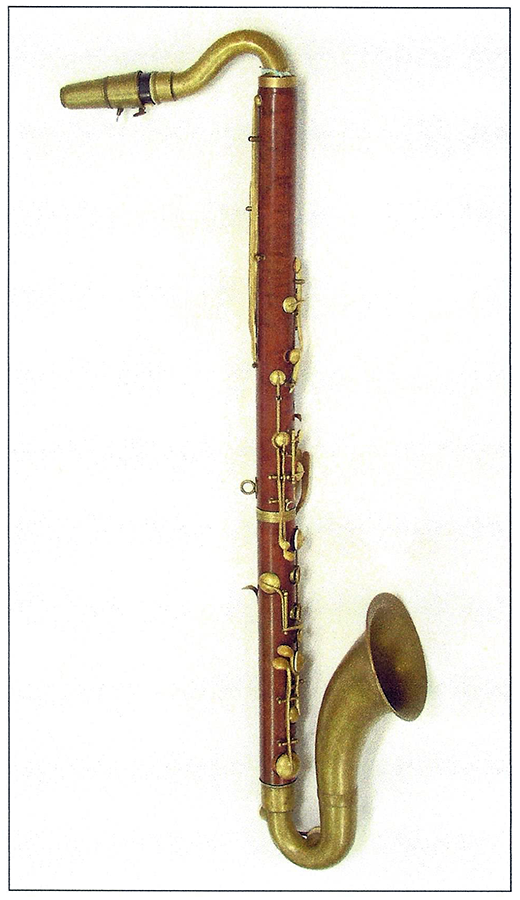 |
Fig. 17 Bass clarinet by Louis Auguste Buffet, Paris, c. 1845 (The Edinburgh University Collection of Historic Musical Instruments, inv. no. 4734) |
During the same time that Sax's straight bass clarinet was becoming well known by its use in the Opera and in bands, a little-known bass clarinet design was being made and promoted by a Parisian maker, Frédéric Widemann, for wind bands. The instrument is an ophicleide shaped bass clarinet made in wood and developed during the 1840s. In his 1855 Nouveau dictionnaire de musique illustré, Charles Soullier includes two engravings (fig. 19) in order to compare an ophicleide shaped bass clarinet called the "Systeme Widmann" with Sax's straight bass called a "clarinette a bec recourbé". 40
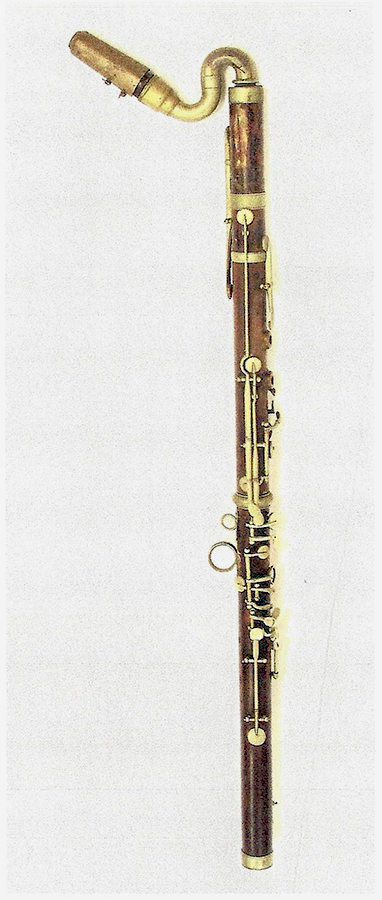 |
Fig. 18 Bass clarinet by Johann Tobias Uhlmann, Vienna, c. 1845 (The Edinburgh University Collection of Historic Musical Instruments, inv. no. 4818) |
A rosewood Bb bass clarinet in Bochum by Widemann is stamped "1847" (Boch um, Städisches Musikinstrumentensammlung, Schloss Kemnade, inv. no. 47) and features a brass section at the lower end in the shape of a U-bend that connects two bores, upward pointing brass bell, and short brass crook to hold the mouthpiece. It has thirteen keys and seven plateau keys expertly arranged on each tube with a very wide bore about 30 mm whose lowest note is E. 41
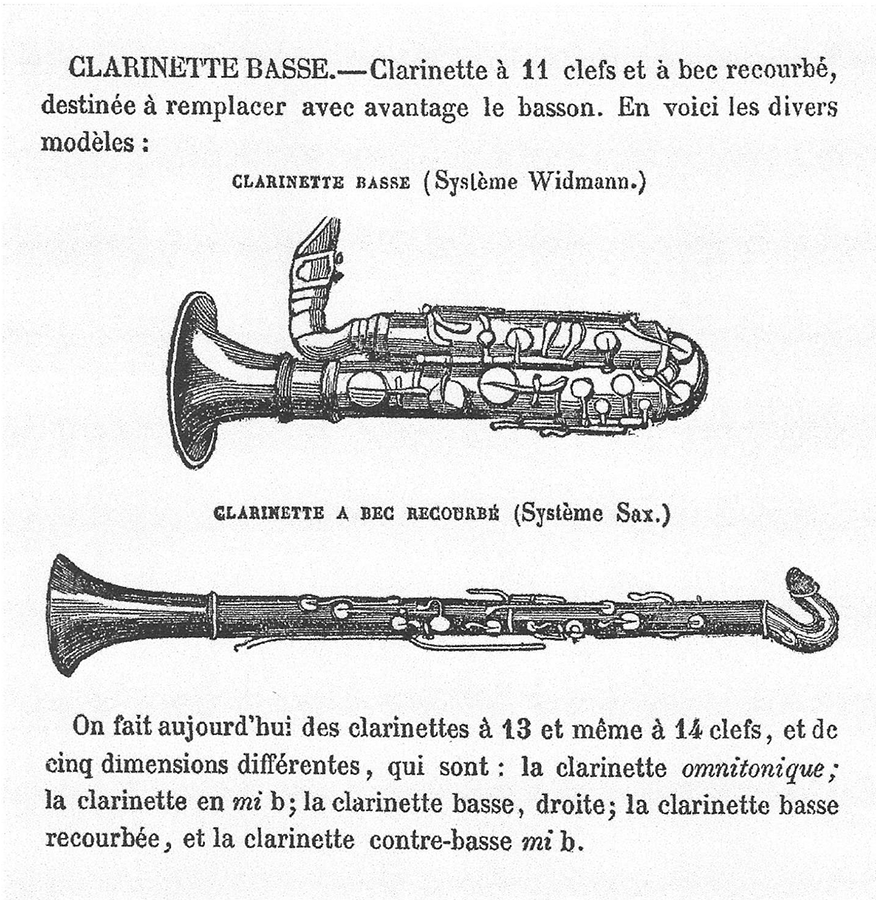 | ||
| Fig. 19 | Engravings of bass clarinets from Charles Soullier, Nouveau dictionnaire de musique illustre, Paris 1855, p. 65 | |
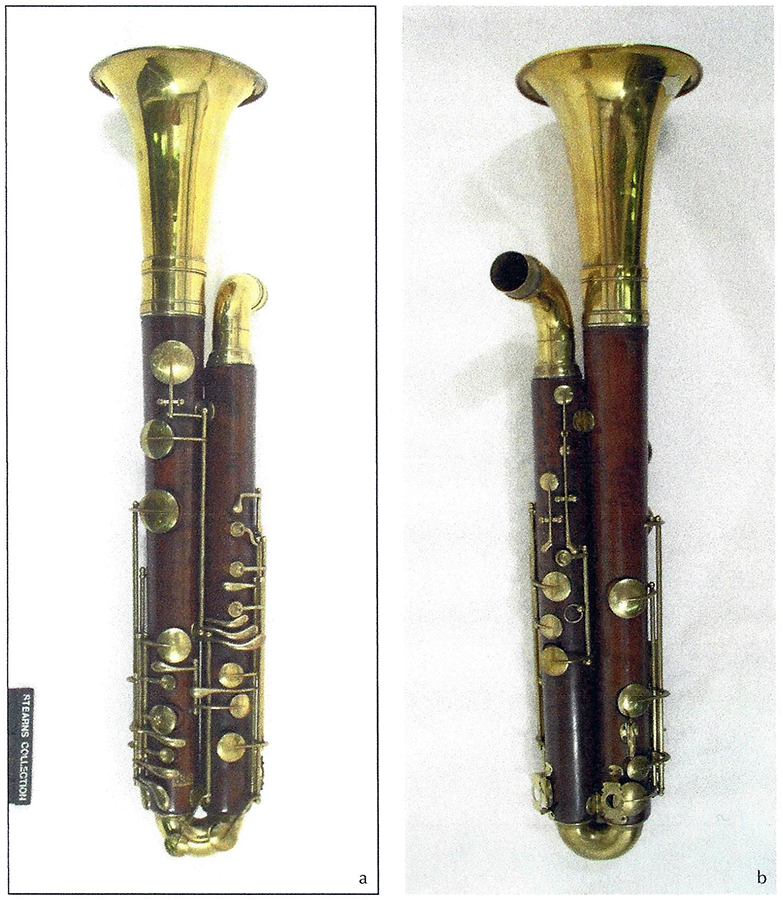
By 1850, Louis Auguste Buffet made ophicleide shaped bass clarinets (fig. 20) very similar to Widemann's, with a wide 30.1 mm bore.42 Later examples of ophicleide shaped bass clarinets were made with a wooden body and brass mouthpiece and bell by Martin frères of Paris (Paris, Musee de la Musique, inv. no. E.1154) and Joseph Uhlmann of Vienna (Munich, Deutsches Museum, inv. no. 43337, whose lowest note is C). Considering all these instruments, it appears that these ophicleide shaped bass clarinets were able to successfully compete for a few years with straight instruments by Sax, Buffet, and other makers.
 | ||
| Fig. 20 |
Bass clarinet by Louis Auguste Buffet, Paris, about 1850 (Ann Arbor, Michigan, Stearns Collection, inv. no. 635) a) front view b) rear view | |
An ophicleide shaped brass bass clarinet used in Germany is Franz Losschmidt's "clariofon" first constructed in 1852. 43 They were made in gold, silver, or nickel silver and five examples are extant. A Bb example in Munich (Deutsches Museum, inv. no. 20506) has fifteen keys and six plateau keys with most of the key work placed on the right tube.44
A similar example but without its bell, is in Edinburgh (fig. 21).45 Judging by the number of extant examples and a similar example in C by Lausmann of Linz (Uhingen, Reil Collection), these ophicleide shaped brass bass clarinets must have been useful in military bands. However, they never achieved a lasting success probably due to difficulties in intonation, evenness, and projection of tone.
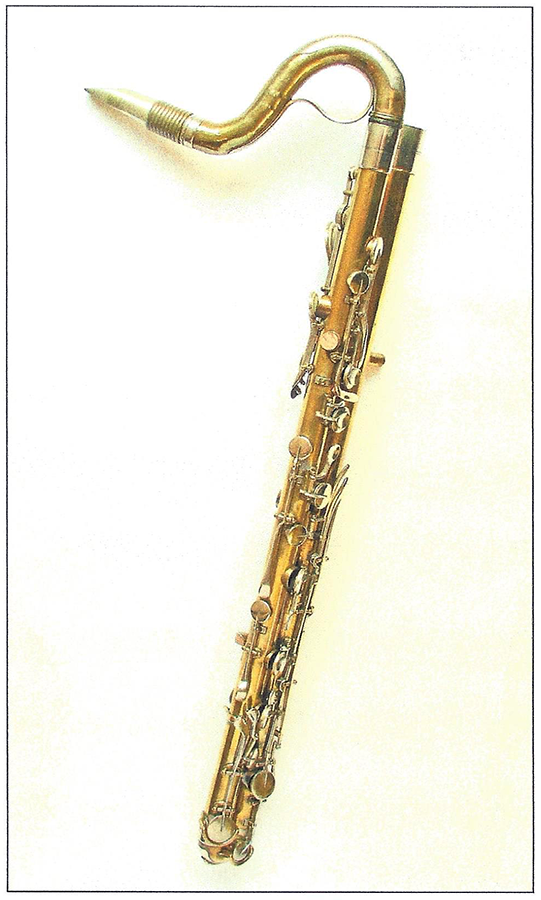 |
Fig. 21 Bass clarinet by Franz Losschmidt, Olmlütz, c. 1860 (The Edinburgh University Collection of Historic Musical Instruments, inv. no. 5703) |
A final bass clarinet design (fig. 22) used in France is an anonymous straight shaped instrument with a small butt joint and pillar-mounted keys for the right hand; and forward-pointing brass bell. It has thirteen keys, five plateau keys, and one ring. A similar example in a French private collection is stamped 1847 (Paris, Kampmann collection) 46 and another by L.A. Buffet was in the de Lery collection in 1910. 47 This design did not become popular but its shape was occasion ally used by mid-nineteenth and early twentieth century makers of basset horns and alto clarinets.
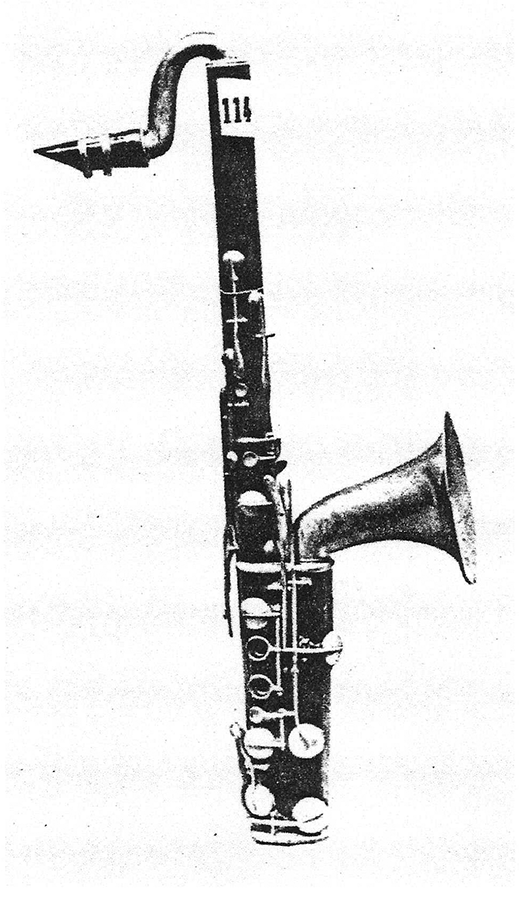 |
Fig. 22 Bass clarinet, attributed L. A. Buffet, c. 1850 (Estissac, Rousselet collection) |
In conclusion, the development and history of the bass clarinet is primarily a series of inventions, compositions, and performances. After playable instruments were available to professional players, a number of composers began to write for the instrument. Bassoon shaped bass clarinets were widely used from the late eighteenth up to the late nineteenth centuries. The least successful designs were the ophicleide and straight with butt joint bass clarinets. Beginning in the 1830s, straight body instruments became the most successful, particularly those made by Sax, Buffet, and Buffet-Crampon. Sax's brilliant designs had a significant influence on several makers in Germany, Austria, and on the prolific Parisian makers. Shortly after 1900, the modern bass clarinet with either Boehm or Oehler systems had evolved and was adopted worldwide.
Figures
| Fig. 1 | Courtesy of the muziekinstrumentenmu seum, Brussels. | |
| Fig. 2 | From David Lewis Kalina, The structural development of the bass clarinet, p. 11, fig. 3. | |
| Fig. 3 | From David Lewis Kalina, The structural development of the bass clarinet, p. 13, fig. 4. | |
| Fig. 4 | Courtesy of the Stadtmuseum Munich. | |
| Fig. 5 | Photographer Jean Jeltsch. | |
| Fig. 6 | Courtesy of the Musikmuseet, Stockholm. | |
| Fig. 7 | Courtesy of the Hessisches Landesmuseum, Darmstadt. | |
| Fig. 8 | Courtesy of the Gemeentemuseum, The Hague. | |
| Fig. 9 | Johann Heinrich Gottlieb Streitwolf, Anweisung, die Bass-Clarinette kennen und blasen zu lernen, Mainz 1833, p. 2. | |
| Fig. 10 | Courtesy of the University of Oxford, Bate Collection; photographer Andrew Lamb. | |
| Fig. 11 | Naples, Conservatorio di Musica San Pietro a Majella, Biblioteca, MS. 29.6.9-10. | |
| Fig. 12 | Courtesy of the muziekinstrumentenmuseum, Brussels. | |
| Fig. 13 | Giacomo Meyerbeer, Les Huguenots: A facsimile edition of the printed orchestral score, with an introduction by Charles Rosen in two volumes, New York 1980, vol. 2, pp. 847-849 (Garland Series of Early Romantic Opera, vol. 20). | |
| Fig. 14 | Courtesy of Edinburgh University Collection of Historic Musical Instruments; photographer Dr. Raymond Parks. | |
| Fig. 15 | Adolphe Sax, Description de la nouvelle clarinette-basse, contrebasse, et bourdon, no. 1051 (21 June 1838), Belgian patent. | |
| Fig. 16 | Courtesy of the Stearns Collection, University of Michigan, Ann Arbor; photographer Christopher Dempsey. | |
| Figs. 17, 18 | Courtesy of the Edinburgh University Collection of Historic Musical Instruments; photographer Dr. Raymond Parks. | |
| Fig. 19 | Charles Soullier, Nouveau dictionnaire de musique illustré: Elementaire, theorique, historique, artistique professionnel et complet, Paris 1855, p. 65. | |
| Fig. 20 | Courtesy of the Stearns Collection, University of Michigan, Ann Arbor; photographer Christopher Dempsey. | |
| Fig. 21 | Courtesy of the Edinburgh University Collection of Historic Musical Instruments; photographer Dr. Raymond Parks. | |
| Fig. 22 | Courtesy of Denis Watel and the late William Rousselet. |
___________________________
1 Albert R. Rice, From the Clarinet d'Amour to the Contra Bass: A History of Large Size Clarinets, 1740-1860, Oxford 2009; see also corrections and additional material in Albert R. Rice, The Bass Clarinets of Adolphe Sax and Their Historical Importance, in: Proceedings of the Clarinet and Woodwind Colloquium 2007: Celebrating the Collection of Nicholas Shackleton, Edinburgh 2012, pp. 82-99.
2 Two single reed instruments are sometimes included in discussions of bass clarinet history. The first is a five key bass chalumeau by W. Kress (A-Salzburg, 8/1) and the second is an anonymous plankshaped one key chalumeau (D-Berlin, 2810, destroyed during World War II). Neither of these instruments was designed to overblow as all bass clarinets are designed, thus, they are both bass chalumeaux. See discussions of these instruments in: Albert R. Rice, The baroque clarinet, Oxford 1992, pp. 32-35; John Henry van der Meer, The typology and history of the bass clarinet, in: Journal of the American Musical Instrument Society 13 (1987), pp. 65-68.
3 Victor-Charles Mahillon, Catalogue descriptif et Analytique du musee instrumental du Conservatoire royal de musique de Bruxelles, Gent 1909, vol. 2, p. 220. See also, Cesar Charles Snoeck, Catalogue de la collection d'instruments de musique anciens, Gene 1894, p. 173; Geoffrey Rendall, The clarinet, New York 1971, p. 139. This instrument was previously in the collection of Adolphe Sax. In 1890, it was exhibited at the Royal Exhibition in London. See Charles Russell Day, A descriptive catalogue of the musical instruments recently exhibited at the Royal Military Exhibition, London, 1890, London 1891, p. 123 and plate V, fig. A.
4 Phillip T. Young, The look of music: Rare musical instruments, 1500-1900, Vancouver 1980, p. 197; Phillip T. Young, A bass clarinet by the Mayrhofers of Passau, in: Journal of the American Musical lnstrument Society 7 (1981), p. 40.
5 John Henry van der Meer, Vivaldi's esoteric instruments, in: Early Music 7/1 (1979), p. 138. Also see the description in Rendall, The clarinet (see footnote 3), p. 140; and the description and photo in David Lewis Kalina, The structural development of the bass clarinet, Ed. D. diss. Columbia University 1972, pp. 10, 11, figs 3, 12. I thank Francesco Carreras for tracing the location of this bass clarinet to the Museo di Val Verzasca in 2007.
6 See the detailed drawing and measurements in Vinicio Gai, Gli strumenti musicali della carte Medicea, Firenze 1969, pp. 221-222, and the brief description and photo in: Antichi strumenti: dalla raccolta dei Medici e dei Lorena alla formazione del Museo del Conservatorio di Firenze, Firenze 1980, pp. 103, 114. The finger holes are dearly seen in the photographs of this instrument in Kalina, The structural development of the bass clarinet (see footnote 5), p. 13, fig. 4.
7 See Young, The look of music (see footnote 4), p. 198; Young, A bass clarinet by the Mayrhofers of Passau (see footnote 4), pp. 36-46; Nicholas Shackleton, The earliest basset horns, in: Galpin Society journal 40 (1987), p. 12; van der Meer, The typology and history of the bass clarinet (see footnote 2), p. 87; Rainer Weber, Ein Bassethorn (Baßklarinette?) des Musikinstrumentenmuseums im Münchener Stadtmuseum aus der Werkstatt Mayrhofer, Passau: Ein Restaurierungsbericht,in: Von denen Instrumentis pneumaticis: Floten, Pommern und Posaunen, Herne 1995, pp. 95-102 (exhibition catalogue).
8 See Michael Finkelman, A provisional world inventory of the lower oboes (oboes grande and d'amore, tailles de hautbois and cors anglais, oboes da caccia, baritone/bass and contrabass oboes) - and Heckelphones in museum and private collections - with photographs and descriptions, historical notes and commentary, MS., 1982.
9 "Lesieur G. LOT, facteur d'instruments à vent, demeurant clans la cour des Moines de l'Abbaye S. Germain, vis-à-vis de la fontaine, vient de faire para1tre un instrument de musique d'une nouvelle invention, sous le nom de Basse-Tube (Basso-Tuba) ou basse de Clarinette. On n'a point encore vu d'instruments d'une étendue aussi considerable. II est susceptible de trios octaves et demie, pleines; il descend aussi bas que le bassoon et monte aussi haut que la flute. Cet instrument, qui est d'une forme rout a fair parriculiere, contient plusieurs clés pour l'usage des sémi-tons, toutes très artistement arrangées et d'un mécanisme fort ingénieux. Les sons qu'il produit, sont très agréables, & si parfaitement sonores, qu'ils imitent de fort près, dans les tons bas, ceux d'un orgue, dans l'action des pédales. Cet instrument étant joué par un habile Artiste, ne sçaurait manquer de produire un très bon effet, & d'avoir l'approbation du public, soit qu'il soit entendu seul, ou dans l'orchestre." Industrie. Nouvelle Instrumente de Musique, in: L'Avant coureur (11 May 1772), p. 292; quoted by Constant Pierre, Les facteurs d'instruments de musique: Les luthiers et la facture instrumentale; precis historique, Paris 1893, pp. 103-104; photographed in Kalina, The structural development of the bass clarinet, (see footnote 5), p. 15.
10 "Monsieur Valenti, vinuose allemande jouera un concerto de sa composition sur un instrument nouvellement invente qui n'a jamais paru en France." Affiches Lyon, 30 August 1769, pp. 187-188. See the database of the Centre de Musique Baroque de Versailles, http://philidor.cmbv.fr.
11 Vacance des spectacles, vol. 2 (April 1774), p. 164, quoted by Constant Pierre, Histoire du concert spirituel, 1725-1790, Paris 1975, pp. 302-303 (Société française de Musicologie). See also Jean Jeltsch, The Basset Horn in France in the Eighteenth Century, in: Proceedings of the Clarinet and Woodwind Colloquium 2007: Celebrating the Collection of Sir Nicholas Shackleton, Edinburgh 2012, pp. 59- 72.
12 See Young, The look of music (see footnote 4), p. 198; Phillip Young, 4900 Historical Woodwind Instruments, London 1993, pp. 99-107. Shackleton states that both Grenser bass clarinets descend to written Bb1>, although Grenser describes his instrument as having a lowest note of B-natural1 and Gerber, who probably copied from Grenser's 1793 advertisement, gave B-natural1 as the lowest note. See Nicholas Shackleton, Bass clarinet, in: S. Sadie and J. Tyrell (eds.), New Grove Dictionary of Music and Musicians, London 22001, www.oxfordmusiconline.com; Gunter Dullat, Klarinetten: Grundzuge ihrer Entwicklung, Frankfurt 2001, p. 76; Ernst Ludwig Gerber, Neues historisch-biographisches Lexikon der Tonkunstler, 1790-1792, reprint Graz 1977, p. 393. Compare the descriptions of the keys given by Robert Eliason in: George Catlin, Hartford musical instrument maker, part 2, in: journal of the American Musicallnstrument Society 9 (1983), p. 36; and van der Meer, The typology and history of the bass clarinet (see footnote 2), p. 69.
13 Its metal crook and mouthpiece were copied from Stockholm's bass clarinet in order to replace these missing sections. Photographs of the Grenser bass clarinet were received by me from the Darmstadt Museum in 2006. The front and back sides of the instrument without a crook and mouthpiece are photographed in Kalina, The structural development of the bass clarinet (see footnote 5), pp. 19-20, 22, figs. 7-8; the from side is photographed in: Musik Instrumente aus dem Hessischen Landesmuseum 16-19. Jahrhundert, Darmstadt 1980, p. 48, no. 50 (exhibition catalogue); and by John Henry van der Meer in: Musikimtrumente: Von der Antike bis zttr Gegenwart, Munich 1983, p. 215.
14 Bestandskatalog zur Sammlung Musikimtrumente des Schlossmuseums Sondershausen, Sondershausen 2001, p. 51 (exhibition catalogue).
15 The author thanks Michael Latcham of the Gemeememuseum for photographs.
16 Johann Heinrich Gottlieb Streirwolf, Anweisung, die Bass-Clarinette kennen und blasen zu lernen, Mainz 1833, p. 2; copy in the Deutsches Museum, Munich.
17 See the description and photographs in Frank Bär, Liebesklarinetten, Bassetthorner, Bassklarinetten, Metallklarinetten: Beschreibender Katalog, Wilhelmshaven 2006, vol. 6, pp. 214-224 (Verzeichnis der Europäischen Musikinstrumente im Germanischen Nationalmuseums Nürnberg, vol. 6).
18 See Rendall in: The clarinet (see footnote 3), p. 143, and photo in pl. 7c. Van der Meer, The typology and history of the bass clarinet (see footnote 2), p. 76, erroneously states that the instrument has seventeen keys. Photographs of the front and back of the "glicibarifono" are found in van der Meer, Musikinstrumente (see footnote 13), p. 215.
19 William Waterhouse, The new Langwill lndex: A dictionary of musical wind-instrument makers and inventors, London 1993, pp. 59, 330.
20 Saverio Mercandace, Emma d'Antiochia (1834), 2 vols., Naples, Conservatorio di Musica San Pietro a Majella, Biblioteca, MS. 29.6.9-10. Much of the solo is transcribed in score form in Rice, From the Clarinet d'Amour to the Contra Bass (see footnote 1), pp. 344-352.
21 12 February 1838, Modena Archives, ASCMO, atti D.S., F. 6; the author thanks Adriano Amore for a copy.
22 See Adriano Amore, La scuola clarinettistica italiana: virtuosi e didatti, Frasso Telesino 2006, p. 36.
23 Rice, From the Clarinet d'Amour to the Contra Bass (see footnote 1), pp. 342-346; Tom Kaufman, Emma d'Antiochia peiformance history, in: Mercadante, Emma d'Antiochia, CD booklet, London 2004.
24 The author thanks Francesco Carreras for a copy of the register and information.
25 The author thanks Gery Dumoulin for photographs of chis instrument.
26 Three photographs of the Paris instrument are available on the website of the Cite de la Musique, http://mediatheque.cite-musique.fr. For a color photo, see Dullat, Klarinetten (see footnote 12), p. 267, fig. 168.
27 Luisa Cervelli, La galleria armonica: Catalogo de!Museo degli strumenti musicali di Roma, Rome 1994, p. 199. A photo (c. 1940) of this complete Papalini alto clarinet when it was owned by the collector Evan Gorga is found in Andrea Cionci, Il tenore collezionista: Vita, carriera lirica e collezioni di Evan Gorga, Firenze 2004, p. 115, fig. 37.
28 François-Joseph Fetis, Instruments nouveaux, Clarinette-Basse, in: Revue musicale 7, no. 16 (1833), pp. 122-123; François-Joseph Fetis, Exposition des produits de l'industrie, Instruments a vent, in: Revue musicale 8 (1834), pp. 171-172.
29 This instrument was studied by the author in 2005.
30 Giacomo Meyerbeer, Les Huguenots: A facsimile edition of the printed orchestral score, with an introduction by Charles Rosen in two volumes, New York 1980, vol. 2, pp. 847-849 (Garland Series of Early Romantic Opera, vol. 20).
31 Bettina Wackernagel, Holzblasinstrumente, Bayerisches Nationalmuseum Munchen, Tutzing 2005, p. 306 (Kataloge des Bayerischen Nationalmuseum, vol. 22).
32 Heike Fricke (author) and Arnold Myers (ed.), Historic musical instruments in the Edinburgh University Collection: Catalogue of the Sir Nicholas Shackleton Collection, Edinburgh 2007, p. 728.
33 Adolphe Sax, Description de la nouvelle clarinette-basse, contre-basse, et bourdon, no. 1051 (21 June 1838), Belgian patent.
34 James Borders, European and American wind and percussion instruments: Catalogue of the Stearns Collection of Musical Instruments, Ann Arbor 1988, p. 44.
35 Malou Haine and Ignace De Keyser, Catalogue des instruments Sax au Musée Instrumental de Bruxelles suivi de la liste de 400 Instruments Sax conserves dans des collections publiques et privées, in : The Brussels Museum of Musical Instruments Bulletin 9/10 (1979-1980), pp. 72-77.
36 Albert R. Rice, From the clarinet d'amour to the contra bass (see footnote 1), pp. 293-295; John Henry van der Meer, Strumenti musicali europei del Museo civico medievale di Bologna, Bologna 1993, pp. 68-69.
37 Fricke and Myers, Historic musical instruments in the Edinburgh University Collection (see footnote 32), p. 730.
38 Ibidem, p. 729.
39 Bär, Verzeichnis der Europäischen Musikinstrumente im Germanischen Nationalmuseums (see footnote 17), pp. 241- 247.
40 Charles Soullier, Nouveau dictionnaire de musique illustrté: Élémentaire, théorique, historique, artistique professionnel et complet, Paris 1855, p. 65.
41 Compare Christian Ahrens and Gregor Klinke, Musikinstrumentensammlung Hans und Hede Grumbt, Bochum 1997, pp. 57-58.
42 Borders, European and American wind and percussion instruments (see footnote 34), p. 44.
43 Thomas Klein, Erfindung, in: Neue Wiener Musik Zeitung 1, no. 26 (17 June 1852), p. 116.
44 A description is in Heinrich Seifers, Die Blasimtrumente im Deutschen Museum: Beschreibender Katalog, München 1976, p. 90. This instrument was studied by me in 2005.
45 I thank Arnold Myers for sending photographs; I studied this instrument in 2007.
46 Bruno Kampmann, Catalogue de la collection d'instruments de musique à vent, vol. 2, Larigot Spécial 1 (1991), pp. 65, 121 (Bulletin de l'Association des Collectionneurs d'Instruments de Musique à Vent).
47 Baron de Lery, Catalogue des anciens instruments de musique, composant l'ancienne collection de M. le baron de Léry, et dont la vente aux enchères publiques aura lieu Hôtel Drouot, Paris 1910, pl. 1, no. 114.


