
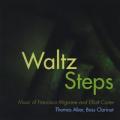
Waltz Steps - Music of Francisco Mignone and Elliot Carter
Tracks
| Track | Work | Movement title | Instrument(s) | Composer | Year | Duration | Audio file | |
|---|---|---|---|---|---|---|---|---|
| 1. | 16 Valsas | I. | Aquela Modinha Que O Villa Nao Escreveu | bass clarinet | Mignone, Francisco Paulo | 1981 | 01:37 | |
| 2. | 16 Valsas | II. | A Boa Pascoa Para Voce, Devos | bass clarinet | Mignone, Francisco Paulo | 1981 | 02:08 | |
| 3. | 16 Valsas | III. | Misterio | bass clarinet | Mignone, Francisco Paulo | 1981 | 02:02 | |
| 4. | 16 Valsas | IV. | Valsa da Outra Esquina | bass clarinet | Mignone, Francisco Paulo | 1981 | 03:13 | |
| 5. | 16 Valsas | V. | Valsa Em Si Bemol Menor (Dolorosa) | bass clarinet | Mignone, Francisco Paulo | 1981 | 03:19 | |
| 6. | 16 Valsas | VI. | Valsa-Choro | bass clarinet | Mignone, Francisco Paulo | 1981 | 03:05 | |
| 7. | 16 Valsas | VII. | Valsa Improvisada | bass clarinet | Mignone, Francisco Paulo | 1981 | 03:09 | |
| 8. | 16 Valsas | VIII. | Apanhei-Te, Meu Claroninho* *(Originally Fagotinho) | bass clarinet | Mignone, Francisco Paulo | 1981 | 01:26 | |
| 9. | 16 Valsas | IX. | 6ª Valsa Brasileira | bass clarinet | Mignone, Francisco Paulo | 1981 | 04:24 | |
| 10. | 16 Valsas | X. | +1 ¾ | bass clarinet | Mignone, Francisco Paulo | 1981 | 02:47 | |
| 11. | 16 Valsas | XI. | Valsa Declamada (O Viuvo) | bass clarinet | Mignone, Francisco Paulo | 1981 | 01:54 | |
| 12. | 16 Valsas | XII. | Pattapiada | bass clarinet | Mignone, Francisco Paulo | 1981 | 02:01 | |
| 13. | 16 Valsas | XIII. | Valsa Quase Modinheira | bass clarinet | Mignone, Francisco Paulo | 1981 | 02:37 | |
| 14. | 16 Valsas | XIV. | Valsa Ingenua | bass clarinet | Mignone, Francisco Paulo | 1981 | 01:42 | |
| 15. | 16 Valsas | XV. | A Escrava Que Nao Era Isaura | bass clarinet | Mignone, Francisco Paulo | 1981 | 04:56 | |
| 16. | 16 Valsas | XVI. | Macunaima | bass clarinet | Mignone, Francisco Paulo | 1981 | 02:32 | |
| 17. | Steep Steps | bass clarinet | Carter, Elliot | 2001 | 3:23 |
Music Information
WALTZ STEPS presents music by two composers from opposite ends of the stylistic spectrum of “art” music from the end of the twentieth century and the beginning of the twenty-first. Francisco Mignone is a traditionalist, whose music looks back to the romantic style of his youth, while Elliott Carter’s music has continually looked away from convention and created new sound worlds throughout his compositional career. Nevertheless, Mignone’s Valsas and Carter’s Steep Steps have much in common. Composed twenty years apart, both of the works were written by composers well advanced in age who had decades of compositional experience and whose musical languages had evolved throughout those years. While Mignone’s music is definitely tonal, Carter’s frequently sounds tonal at a given moment, but then quickly moves on. All the pieces are miniatures averaging around three minutes in length. Mignone’s Valsas each have a distinct character, while Steep Steps shifts character and mood from phrase to phrase.
Francisco Mignone composed his Sixteen Waltzes for Solo Bassoon in 1981. Mignone was born in Sao Paulo, Brazil in 1897 and worked in dance bands there as a flutist and pianist at an early age. He went on to have a lengthy and successful career as a composer, conductor, and teacher in Brazil, where his compositions remain well-known. His musical language is firmly based in the tonal and harmonic world of his youth and often incorporates melodies and syncopations from Brazilian popular music. The Sixteen Waltzes are nostalgically reminiscent of Sao Paulo and Rio de Janeiro during the 20’s and 30’s and of the music of Ernesto Nazareth. All written in minor keys, the Waltzes are unique as a large-scale, multi-movement work for a solo wind instrument, in particular the bassoon, or in this case of this recording, the bass clarinet, both being instruments seldom heard alone at length. The similarities between the bass clarinet and the bassoon outweigh the differences between the two instruments and make the Waltzes an ideal expressive vehicle for bass clarinetists, whose repertoire has grown in recent years, but who are nevertheless constrained by their instrument’s years of neglect to appropriate pieces in an older, romantic style from music originally written for other instruments.
Steep Steps was composed by Elliott Carter during the summer of 2001 for his friend Virgil Blackwell, whom he had known since working with Blackwell, a member of New York’s Speculum Musicae ensemble, during the 1970s. In the brief note which accompanies the score, Carter states that the piece’s title refers to the fact that clarinets, unlike other instruments, overblow at the twelfth, a large interval important in the melodic contours of the piece. He does not mention that the interval of the minor sixth, the next partial available in the clarinet’s overtone series, is also important to the melodic contours of the work. Nor does he describe Steep Steps, which although obscured by his use of metrical modulation, a technique he devised for giving each figure in a work its own independent tempo, is notated in 3/4 time, as a waltz. Whether it could be interpreted as such, heard through a temporal prism breaking the music from a single plane into small fragments juxtaposed at odd angles, is up to the listener.
Thomas Aber, D.M.A., is a native of Kansas City, Missouri. His study of the bass clarinet has led him to the Juilliard School in New York and to Amsterdam, where he studied with Harry Sparnaay on a Fulbright-Hays grant. During his stay of several years in The Netherlands he was a prize winner in The Gaudeamus Foundation International Competition for Interpreters of Contemporary Music. He has given American and/or world premieres of numerous works. Bass Clarinetist with the Omaha Symphony since 1990, Dr. Aber is also a founding member of newEar, Kansas City’s ensemble for new music and of the Myth-Science Ensemble.
Album Information
Recorded in 2014 at White Recital Hall, Conservatory of Music of the University Of Missouri at Kansas City
Engineered by Robert Beck
Mastered by David Brock at AudioVision Productions, Overland Park, Kansas
Original art works by Gregor Pierce
Art direction and design by Rhondda Francis
Production consultation by Dwight Frizzell
earThis!
PO Box 15748
Kansas city, MO 64106
Engineered by Robert Beck
Mastered by David Brock at AudioVision Productions, Overland Park, Kansas
Original art works by Gregor Pierce
Art direction and design by Rhondda Francis
Production consultation by Dwight Frizzell
earThis!
PO Box 15748
Kansas city, MO 64106


